How much leverage is the right amount?

Stacks Image 806
It is common for people to use leverage, whether in the form of leveraged ETF's, margin, or futures as a way of enhancing returns when things are going well in the markets. The problem is that leverage cuts both ways, it can dramatically increase your gains, and it can also dramatically increase your drawdowns.

It is not only retail investors getting 'greedy' using leverage either, did you know that not only do Hedge Funds use a lot of leverage, but even Berkshire Hathaway is usually using leverage? I didn't dig into it, but it appears that they often use 1.2x to 2.0x leverage, and they are generally considered to be conservative. You may recall how Long Term Capital Management blew up from using too much leverage, when things went against them.

Having looked at the risk adjusted returns for holding leveraged ETF's for long periods of time, it is shocking how much volatility and drawdowns they can incur. But Fear Of Missing Out, FOMO, still taunts people to try and enhance returns.

I got more aggressive in 2021, not long before the market rolled over and got stung as a result. Not a mortal wound, but a good lesson to not leverage up too much. The truth is, I was leveraged more than I was comfortable with, but it didn't rear it's ugly head until things turned downward.

Many of the DMS strategies take advantage of Smart Leverage, which is designed to only leverage up when the odds are in our favor for doing well, however, this doesn't mean that being 100% invested in LT Gain++ is a terrific idea because there will be times when you are 300% leveraged. Certainly some people can handle that volatility, not me!

With less than a week to go before June has completed, it looks like we may trigger Smart Leverage this month. As a reminder, Smart Leverage looks at drawdowns in IWB from the month end high water mark to the current month end results, when this reflects a drawdown of 15% or greater, Smart Leverage is triggered, and when we go back into equities we do so with leverage. The "+" strategies use 2X, SSO, the "++" strategies use 3X, UPRO.

Triad only has a maximum allocation of 1/3rd to IWB, the Russell 1000. So even if you are in Triad++, the maximum leveraged position you have to the market is 100% for the IWB portion (1/3 x 3X), and it could still have 1/3rd in either Russell Mid-Cap Value, or Foreign, and also up to 1/6th position in either Gold or Commodities. This is an amount of leverage that I am personally good with. At this point in my life, I don't want the volatility or risks that come from being overly leveraged and my recent fall from grace was an excellent reminder of this. If you don't learn from your mistakes, you are likely to repeat them.

If you are investing in the DMS strategies, please consider the leverage you will be taking when we go back into equities if/when Smart Leverage is triggered. It would not be out of the question whatsoever to see a 20% loss in a month for the overall market, and if you are 100% in 3X leveraged strategies, that would equate to near a 60% loss for the month. That would be a significantly huge loss in the span of one month. Caution is advised. Consider your allocation, and not just how you will do if things work out as we hope, but please also consider the downside possibility and what that would mean for your portfolio.

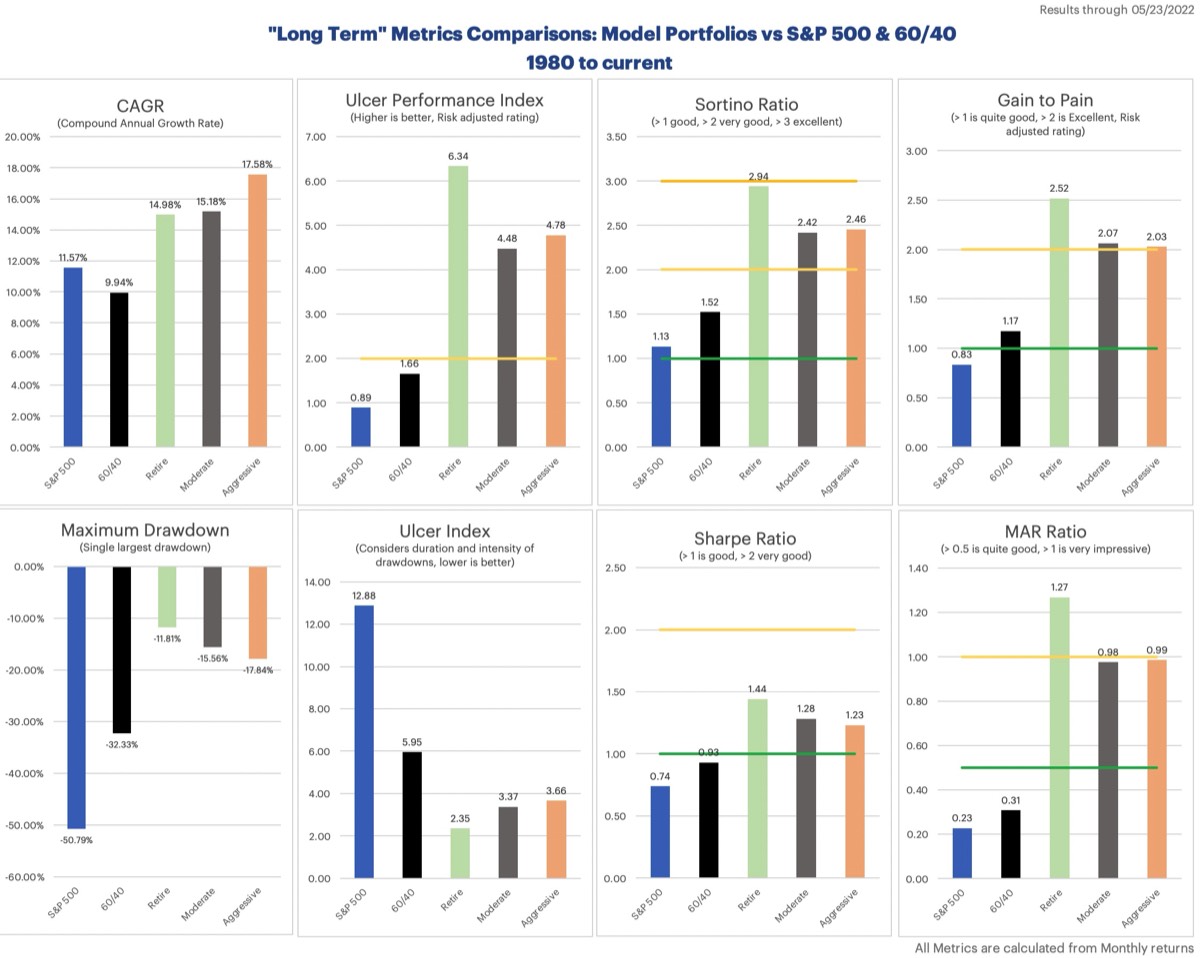
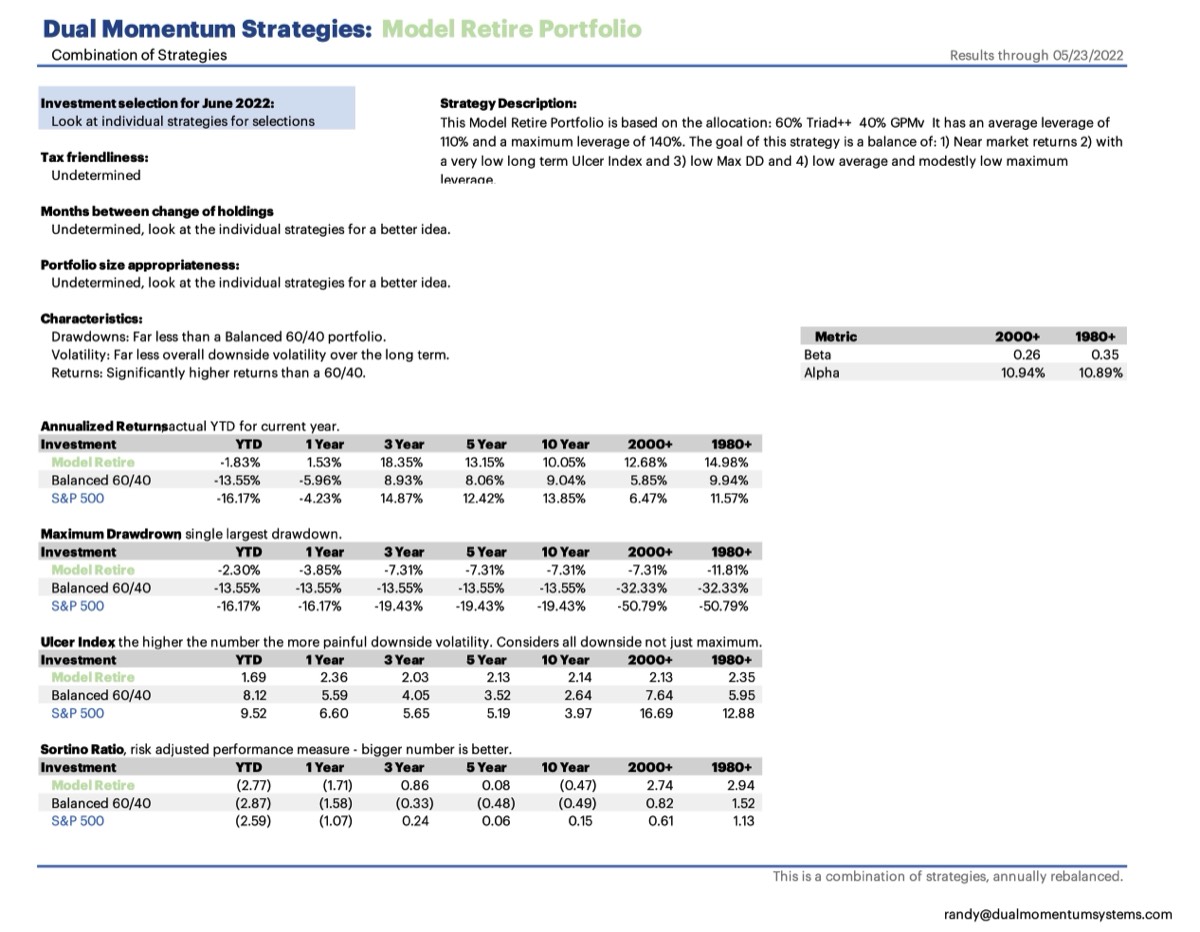
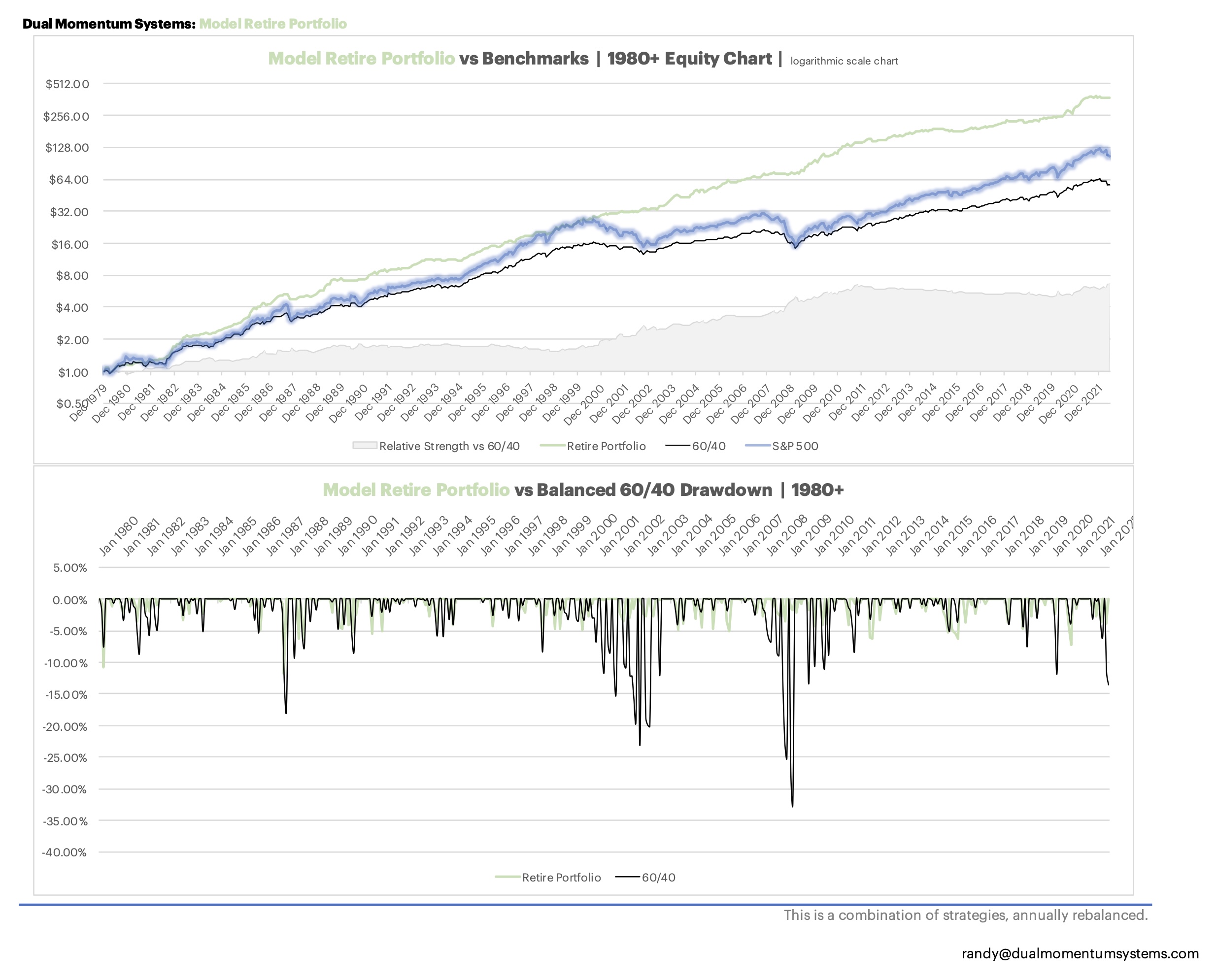
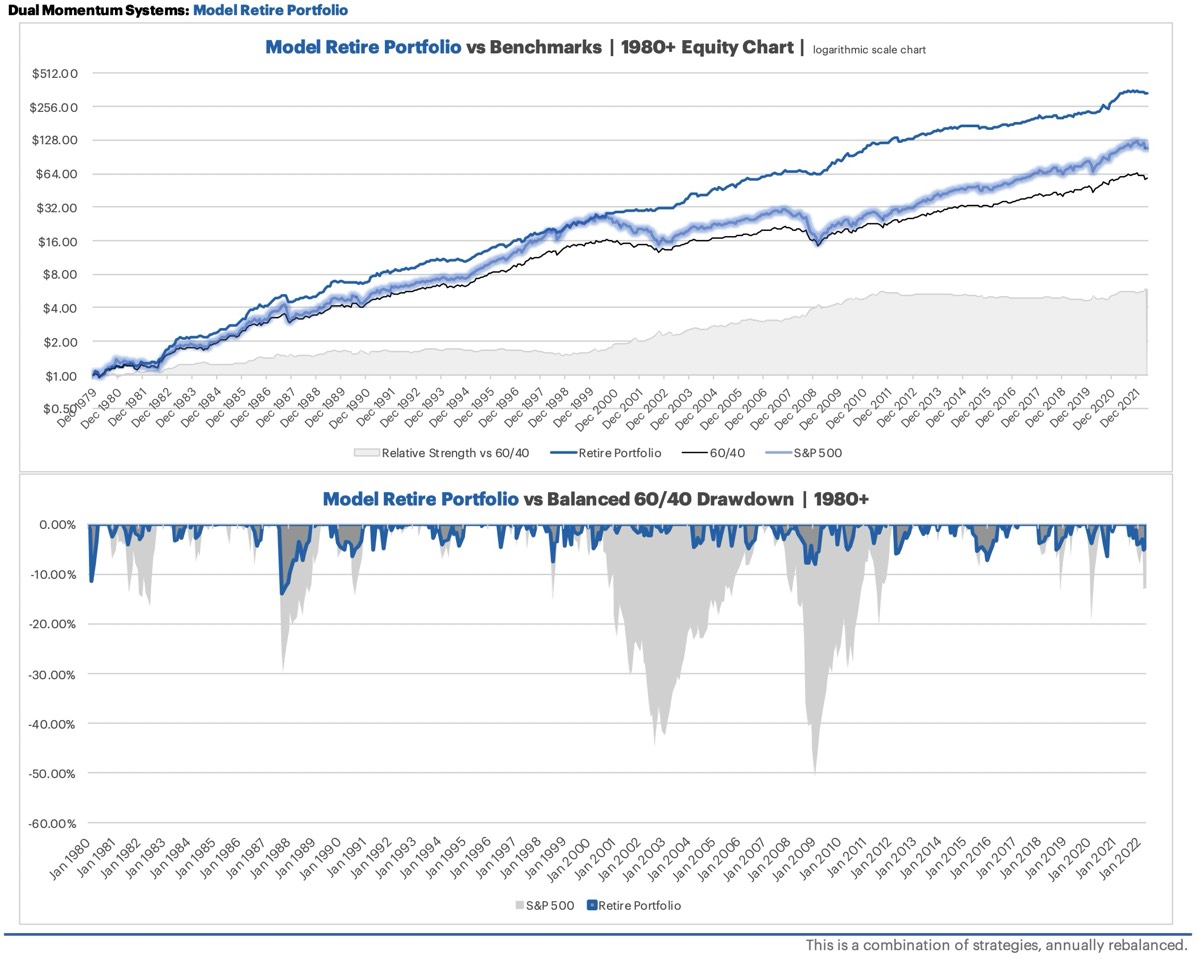
My personal allocation is similar to the Model Portfolio Retirement allocation as shown recently in the Reporting Decks. Which is 35% GPMv, 50% Triad++, and 15% IWR (Russell Mid-Cap). As shown in the reporting deck, this allocation has a backtested history of terrific returns that are above market performance, with far less volatility and drawdowns. Seems like a great path for me to follow. Note that I do have my kids more aggressively allocated, but not too much maximum leverage. The Reporting Decks show both the Maximum and Average Leverage for each strategy and Model Portfolio. While the Average Leverage is important to note, it is the Maximum Leverage that one needs to pay the most attention to.
Stacks Image 815

GPMv is born

When I was scouring the internet, gaining interest in Tactical Asset Allocation strategies, TAA, I found myself on JW Keuning's website Index Swing Trader by his online name TrendXplorer. TrendXplorer and his co-hort in several strategies Wouter Keller have come up with some really interesting strategies. They iterated Protective Asset Allocation, PAA, to become Generalized Protective Momentum, GPM. The goal as TrendXplorer told me was extremely low drawdown, low drawdowns were given higher priority over returns. When I first ran across GPM, honestly I thought it was rather unique and brilliant how they used the correlations and used the positive count to scale into and out of the Risk On universe and the Safety assets. However, I also thought - BORING.

Some times, boring is good, in fact boring can be great. It took me a few years to come around to it, but I recently found myself investigating retirement portfolios for myself, not for today - but not too far off in the future. It was during this investigation that I found myself looking at GPM once again, and viewing it in a different light.

When people are accumulating assets, it is often the case that more risk and less diversity is taken. This can work well for capital growth, albeit likely accompanied with higher volatility. In retirement though, steady eddy is the goal. The lower the volatility the more reliable a portfolio is for drawing money in retirement without too large drawdowns. It is why allocation strategies like Golden Butterfly, Permanent Portfolio, and All Weather each far outperform the general market in retirement, they are far less volatile than the overall market and this keeps drawdowns from getting too large.

If you are familiar with this Dual Momentum Systems website, you likely know that my Global Navigator+ strategy is largely a derivative of Gary Antonacci's GEM strategy. I have a faster acting weighted lookback, and have implemented Smart Leverage for greater growth opportunities and Treasury Duration Limiter for safer Risk Off, but in a general sense you can see the resemblance. The Russell is a bit more varied from GEM. The LT Gain strategies, like Global Navigator+ you can see have inspiration from GEM, again with my take on them with the Single Momentum, the lookback, Smart Leverage, and Treasury Duration Limiter. The Triad Strategies are I would like to think wholly my own, there may be resemblance to other strategies, but I really came up with them without any inspiration of other strategies. I mention the strategies only to say that when I re-visted GPM, I found myself wondering, what if I changed this, and that, hmm, what about this. Compulsion forced me to tinker with the already excellent strategy to see what the effects of my ideas would have.

When I re-familiarized myself with GPM, as mentioned above, I began wondering how the strategy would perform if I made some changes to it. I will run through the changes that I pondered, and eventually tested, and a brief mention why I was looking at the specific change.

  1. Japan, one of the risk on assets in GPM is EWJ, Japan. While this choice didn't offend me, I wondered why not use a more broad geographical index like Pacific which is the entire region, not just Japan. Recently, the top countries represented in the Pacific ETF VPL were: 55% Japan, 20% Australia, 13% Republic of Korea, 7% Hong Kong, 3.4% Singapore, 1% New Zealand.
  2. Russell 2000, I have an affinity for Mid-Cap Russell indexes and wanted to see how the Russell Mid-Cap would do when swapped in for the Russell 2000 (small cap) index.
  3. Emerging Markets, I didn't like the idea of allocating up to 33% to Emerging Markets so I want to remove it entirely.
  4. Safety Assets, I wasn't sure why there wasn't an option to not just go into Short Term or Intermediate Treasuries, given the goal of the strategy I thought that BIL should also be an option.
  5. The strategy multiplies the returns and correlations and adds up the positive results, this number is used to scale into and out of the Risk On and Safety assets. Given the protective, low drawdown, nature of this strategy, I wondered, what if I add 1 to this count to force it to allocate a bit more to Risk On instead of the Safety assets.


After updating my implementation of TrendXplorer's GPM model and verifying the results where correct, I then began implementing my 5 ideas one by one to see how they worked out. My initial look at a strategy consists of looking at the CAGR, Maximum Drawdown, and UlcerIndex, here is what I found with the 5 changes listed above:

GPM, the base strategy has (from 1980 through May 23, 2020 - with my data set of returns): 10.90% CAGR, -7.93% MaxDD, 2.35 UlcerIndex

The changes below are individual, 1 looks at only changing Japan for Pacific, 2 only looks at changing Russell 2000 for Russell Mod-Cap, it isn't stacking Japan and Russell 2000 changes.
  1. VPL instead of EWJ: 10.86% CAGR, -9.13% MaxDD, 2.46 UlcerIndex I was okay with this being slightly worse, I knew that Japan had incredible returns during the late 80's, so de-prioritizing that a bit was likely to have a little bit of an adverse effect. I was more of the mind that Pacific was a more well rounded selection and maybe better going forward.
  2. Russell Mid-Cap instead of Russell 2000: 11.23% CAGR, -7.93% MaxDD, 2.33 UlcerIndex. This was a bigger improvement than I would have guessed.
  3. Removing Emerging Markets from the universe of Risky Assets (and changing calculations from using "12" to "11"): 10.79% CAGR, -9.35 MaxDD, 2.35 UlcerIndex. It surprised me that the MaxDD was a little higher, but not that the UlcerIndex was slightly lower and the CAGR slightly lower.
  4. Adding BIL as an option if both SHY and IEF had negative lookback: 11.27% CAGR, -7.93% MaxDD, 2.23 UlcerIndex. This is even better than I would have guessed.
  5. Changing the count of positive correlation * return assets by 1 to increase Risk On scaling: 11.65% CAGR, -10.05% MaxDD, 2.54 UlcerIndex. Spot on.


Each of the 5 changes seemed reasonable to me, and the 5 changes still keep the essence of the strategy in tact, these are more stylistic preferences than anything. This still very much looks and smells like GPM.

Question, What are the results of putting all 5 of those changes together?
Stacks Image 742
Serendipity, Synergy. Call it what you will, but I saw fireworks when I looked at the historical results of putting those 5 tweaks into the base GPM strategy. GPMv, short for GPMvariant, is what I am calling this strategy. It is the base GPM strategy with all 5 changes mentioned above, and I also swapped out SHY for VGSH, and IEF for VGIT, simply because I already use both VGSH and VGIT in my other models.

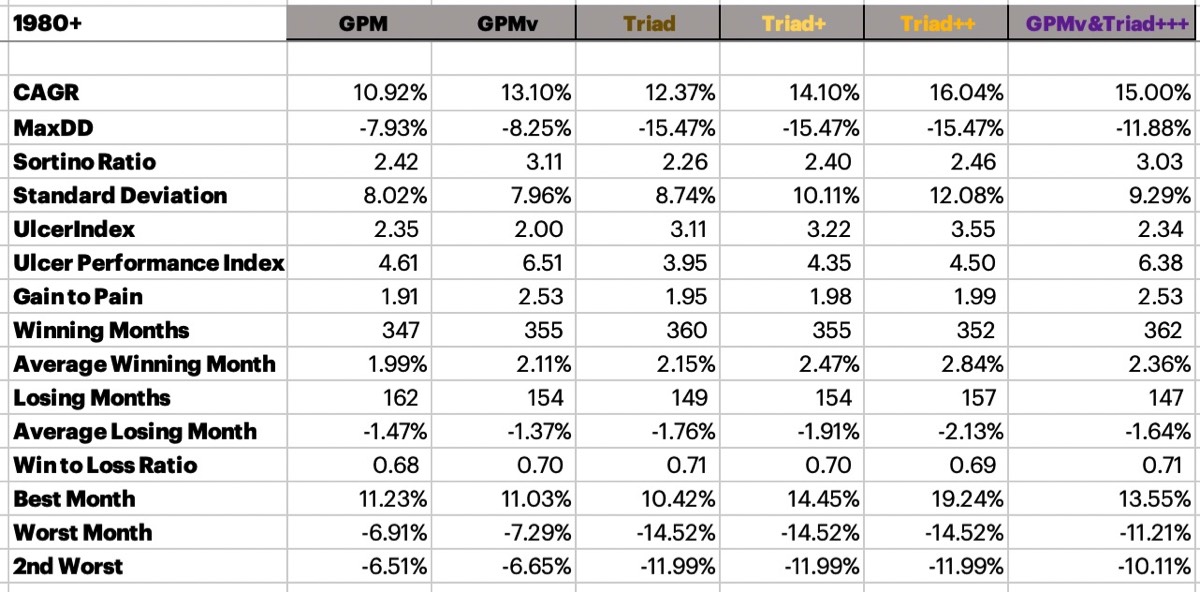
GPMv: 13.10% CAGR, -8.25% MaxDD, 2.00 UlcerIndex.

WOW - those are some seriously impressive numbers. S&P beating returns with such low drawdowns and low volatility.

The next step for me was combining GPMv with my Triad++ strategy. Given my personal risk profile, I did 40% GPMv and 60% Triad++.

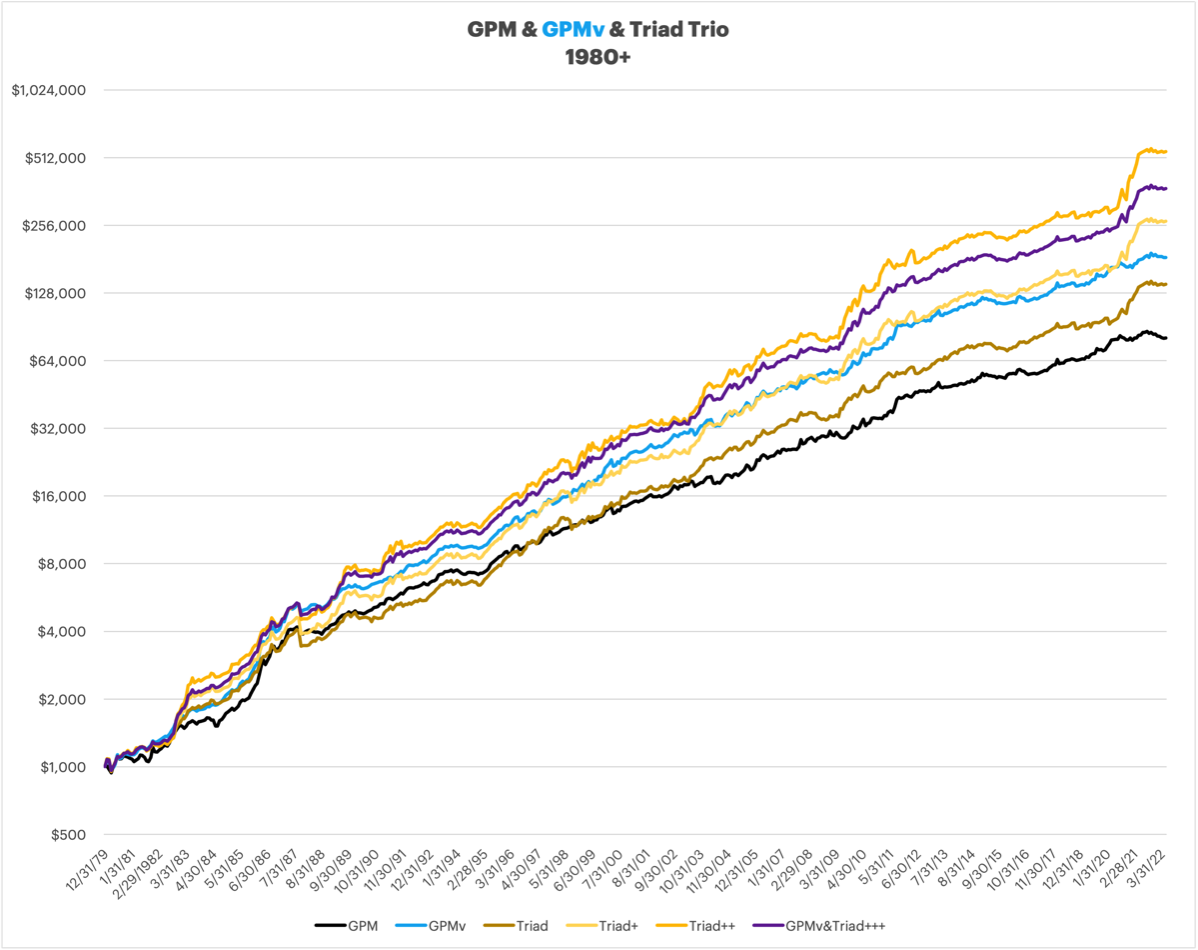
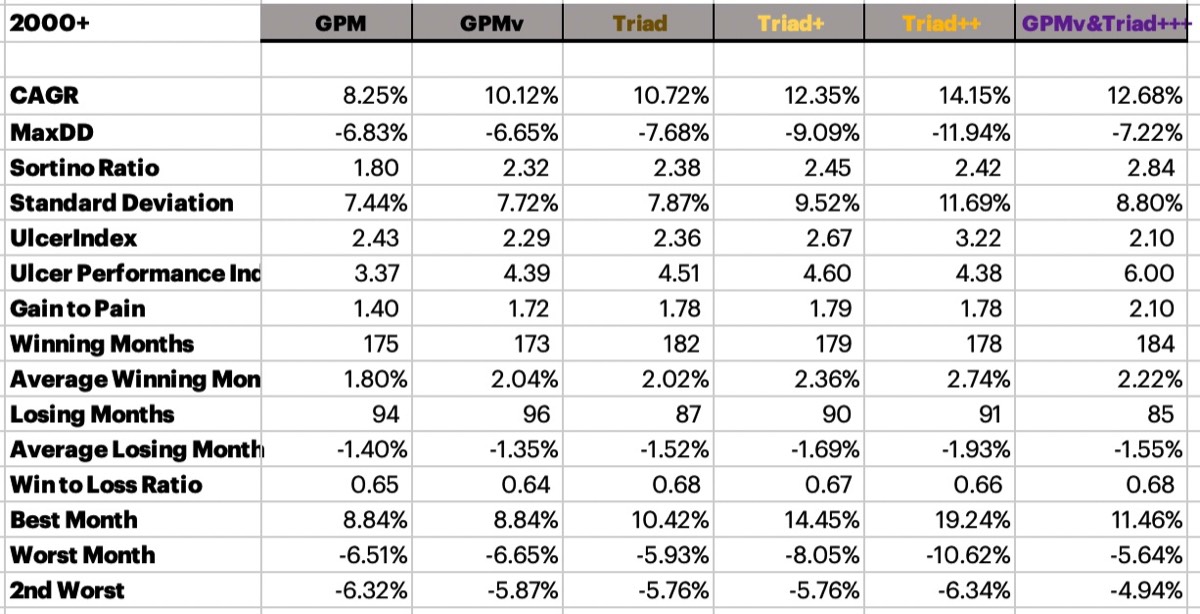
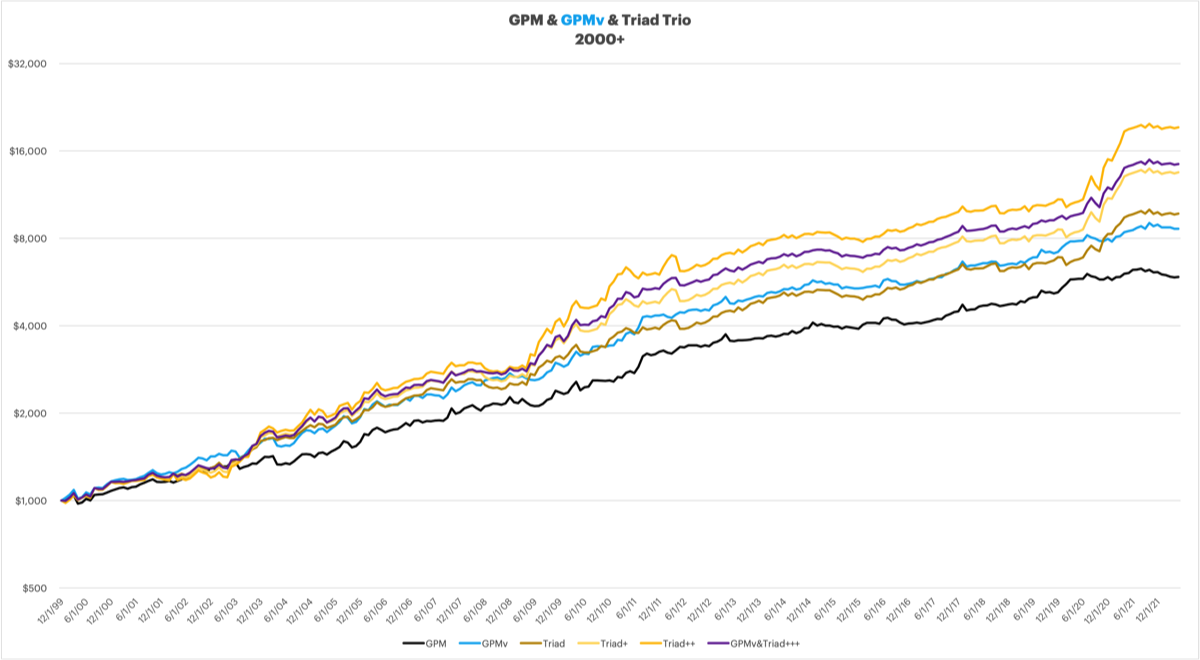
Below are the metrics the related strategies and combination for both 1980+ and 2000+.
Stacks Image 749
Stacks Image 752
Stacks Image 756
Stacks Image 760
In the metrics and Fact Sheets below, the "Model Retirement" portfolio consists of 40% GPMv & 60% Triad++.
Stacks Image 768
Stacks Image 775
Stacks Image 772
Can we be certain that GPMv will perform as well in the future? No, of course not. However, regardless of the actual returns this strategy generates going forward, I think it is safe to say that it will continue to generate similar to market like returns over a full business cycle, and it will do so with far smaller drawdowns and far less volatility than a market portfolio. Isn't that about the best we could really ask for?

While I am not there yet, I am planning on GPMv to account for 40% of my retirement portfolio.

VTI out, IWB in: House Cleaning

VTI was still being used in Global Navigator+ while all of the other strategies used IWB. In efforts of streamlining and simplifying, I have changed Global Navigator+ ever so slightly by replacing VTI with IWB. There is virtually zero impact to past results or drawdowns, simply a housecleaning measure.

Strategy Naming Convention: House Cleaning

When naming the three Triad strategies which are differentiated only by the use of Smart Leverage, and 2X, and with 3X Smart Leverage I used Triad for the base strategy without any Smart Leverage. Triad+ for Smart Leverage using 2X, and Triad++ for Smart Leverage using 3X. I like this naming convention and adopted it to the other strategies as well.

LT Gain is now LT Gain+, LT Gain 3X is now LT Gain++, Global Navigator is now Global Navigator+.

Consistency in the naming.

TDL and the Triad Trio

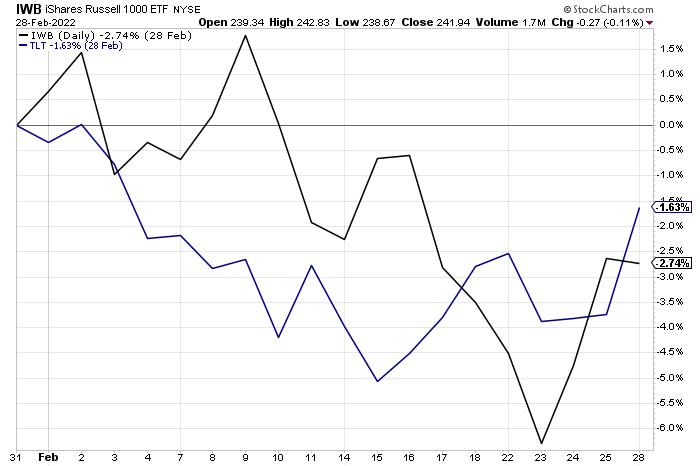
The strategies (not Triad, it uses a different lookback and different risk off treasuries and bonds) went into treasuries for the months of February and March this year. During the month of February, treasuries didn't end the month terribly even though they underperformed the Russell 1000 most of the month, this chart below shows February 2022 for long duration treasuries and the Russell 1000. The treasuries lost about 1% less than the market.
Stacks Image 681
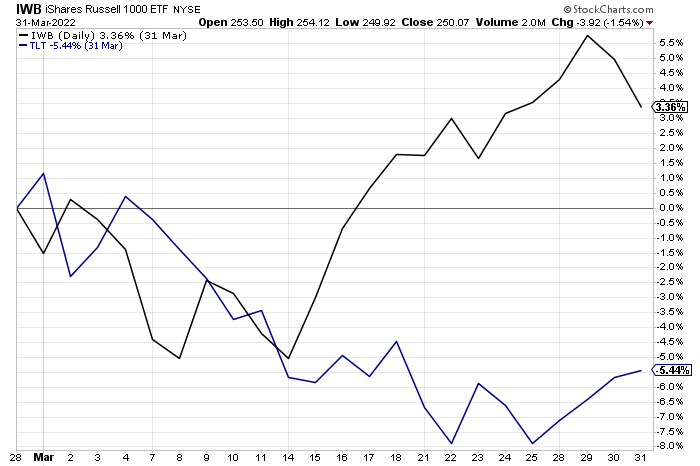
March was far worse for treasuries. Traditionally the treasuries act as a flight to safety and provide safety and returns when stocks aren't doing well, this didn't happen the 1st half of the month as stocks went down, Treasuries were down equally, then as the equities recovered and made gains, the treasuries lagged tremendously. Treasury yields have seen some of the biggest increases in this short of a time and has been devastating for the price of treasuries and bonds, especially the longer duration ones.
Stacks Image 687
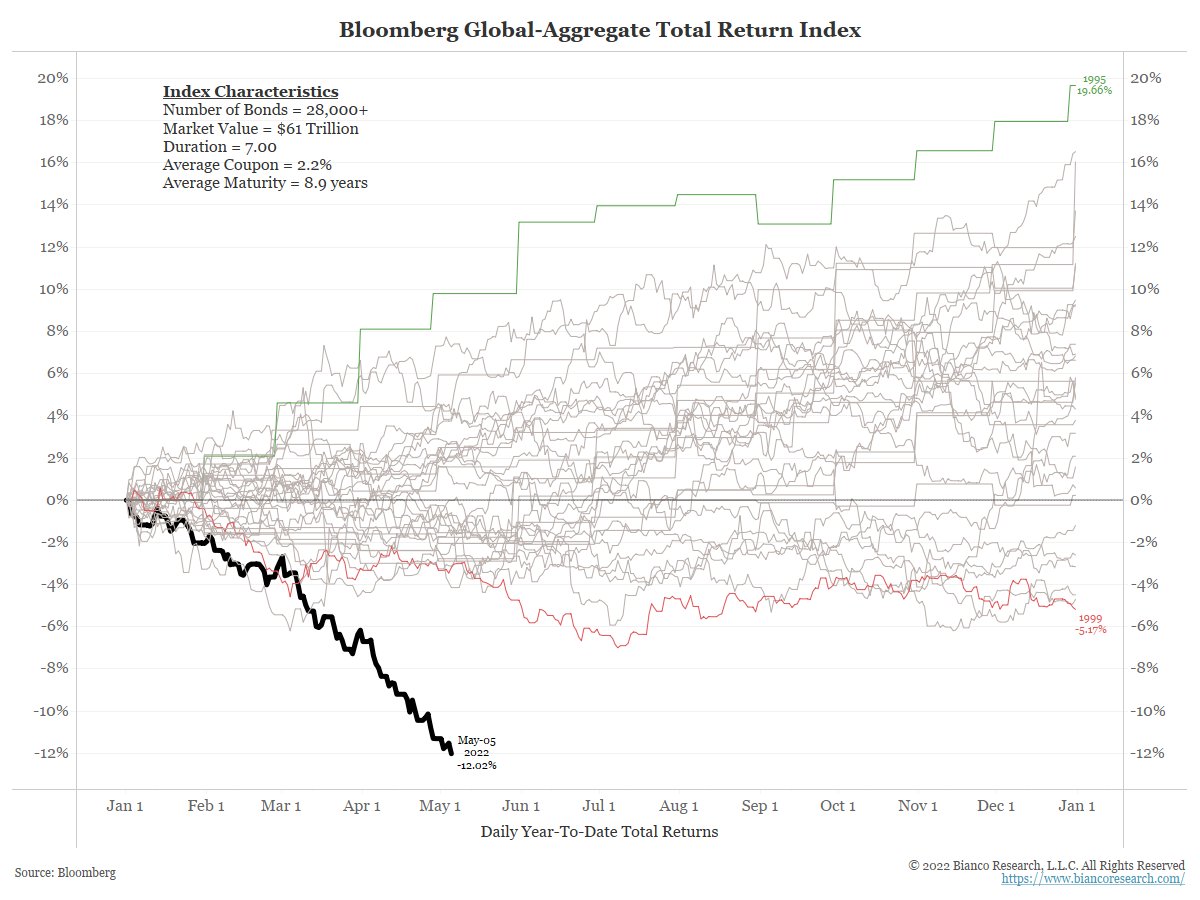
This chart below, tweeted by Jim Bianco, shows the treasury returns year to date for all history available - this is the worst year on record so far. Just crazy, we've not seen this happen before.

The result is that we took a hit in March in the strategies like The Russell, Global Navigator, LT Gain, and LT Gain 3X. They went out of equities based on the model and ended up performing terribly in long duration treasuries.
Stacks Image 678
TDL, Treasury Duration Limiter, is something that I came up with after that terrible treasury performance in March, the goal is to restrict the strategy to short duration treasuries when going long duration presents too high of a risk. I ended up making TDL operate on the 30 year treasury yield, subtract the 5 year treasury yield, and if the spread is less than 1% then TDL kicks in and the strategy would go into short term instead of long duration treasuries.

Recently, I have been looking into TrendXplorer's Generalized Protective Momentum, GPM, strategy - it is of interest to me, particularly in a retirement portfolio. I found myself thinking about the strategy and making a couple changes based on my perspective to see how it looked on historical data. In my making a few adjustments to GPM I found myself implementing a TDL type filter for GPM, and it dawned on me that it should also work well for the DMS strategies.

It is elegantly simple, and works better than the 30 year - 5 year treasury yields so I have swapped out the inner workings of the TDL filter. TDL now simply looks at the weighted lookback of long duration treasuries, my weighted lookbacks for the strategies are 25% of the 1 month return, 25% of the 3 month return, and 50% of the 6 month return. However, I wanted this to be faster acting and more protective, so I changed the weighted lookback to 50% of the 1 month return, 25% of the 3 month return, and 25% of the 6 month return.

If we are risk off for multiple months, TDL can kick in at any month end, maybe in February we start off in long duration treasuries, but TDL kicks in for March so then we switch to short duration treasuries. The way I have TDL set, if in April the new signal is for long duration treasuries - we stay in the TDL limited option until we go back into equities. It avoids switching back and fort from long to short treasuries for those times when it is many months, the returns are not hurt and volatility is lowered.

I wish I had come up with this originally, I had it in my head that the risk off asset should be restricted from an outside metric, but as always, price is usually the best metric available.

This additional filter, TDL, to the strategies will help to protect us any time the long duration treasuries may not be a safe place to park our investments. The reporting deck for May will be complete with the updated TDL.
The Triad Trio!

Triad is one of the newer strategies, and it has become one of my favorites. When I was originally designing Triad last year, I wanted to include both gold and or commodities as up to a 1/6th investment option, but I wasn't able to source commodities monthly returns back to 1980 so decided to just leave it with gold as the option. I recently was able to obtain the monthly commodities returns back to before 1980 and have implemented it into the strategy.

The strategy will invest 1/6th of the strategy into either gold or commodities, whichever has the stronger relative momentum, and if neither has positive absolute momentum, then that 1/6th is invested into our safety holdings, treasuries or bonds.

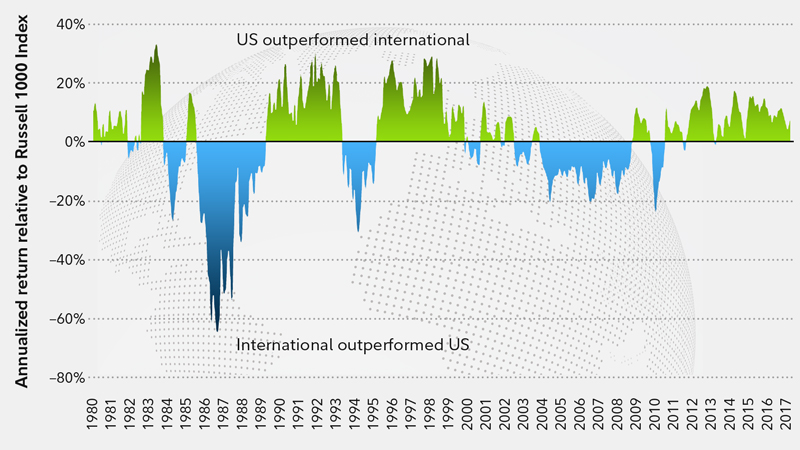
I've decided to make Triad a little more robust in regards to International equities, similar to Global Navigator. Recency bias has everybody looking away from International and at the US Markets, but historically up until about 12 years ago, International markets had the same historical returns as the US, and they tend to outperform when the US Markets are underperforming.
Stacks Image 704
The chart above shows how there are periods when the International markets have outperformed the US markets. Triad now capitalizes on this situation. Similar to how Triad now invests in the stronger of gold or commodities, it will put 2/6th of the strategy into either the Russell Mid-Cap Value or International, whichever has the higher relative momentum. If neither of them have absolute momentum, then the 2/6th goes into the best performer of the bonds/treasuries.

The 2/6 allocation into the Russell 1000 remains unchanged.

Triad+ is the same as Triad, but adds Smart Leverage and will go into 2X S&P 500 instead of the Russell 1000 when going back into equities after a 15% or larger drawdown in the Russell 1000. This position is held until a natural change of investments in the strategy up to 1 year at which time the position is closed and we would de-leverage into the Russell 1000.

Triad++ is the same as Triad+ but the 2/6th position that would go into the Russell 1000, with Smart Leverage in Triad++ it would go into 3X S&P 500.

Even using 2X and 3X leverage with the 2/6th position the risk adjusted returns on the strategy are phenomenal, and for me it becomes a single strategy that fits more needs without having to combine multiple strategies. Note that leveraged equities do present a risk, a terrible month in the markets is amplified if in leveraged assets. This is not investment advice.

Going forward with the May Reporting Deck, all three Triad strategies will be included.

You can download the Fact Sheets for all three Triad strategies here.

I am really excited for the Triad offerings and am using them heavily myself. Please pay attention to the MAX Leverage of strategies. Triad++ has a 166% max leverage on it's own. the 2/6 position will effectively become 6/6 in Triad++ when it goes into UPRO. Triad always has at least 1/6 in treasuries/bonds, I personally don't consider that a 1:1 leverage the same as equities, but I didn't want to downplay the overall effective leverage all the same.

Happy Investing, geez, especially in this environment. If the couple people I follow who's opinions I respect are correct, we could see a really big drop still to come in the equities markets. Dual Momentum Systems strategies have had some whipsaw this year, and got caught in long duration treasuries in March, but they should fare well if faced with a large drawdown in the markets, and get us back in when they have some positive momentum.